

Padel in Switzerland, how a new game is finding its courts
In one year the padel clubs within Swiss Tennis grew from 13 to 52 and the licences more than doubled. What is behind the growth, why indoor courts matter and how visitors find a game.
Padel arrived late in Switzerland, and then it arrived quickly. The game that grew up in Spain and spread through Italy and Sweden has found a natural home in a country of tennis clubs, indoor halls and long winters. The official figures from Swiss Tennis tell the story better than any slogan, and they also explain how a visitor can join in.
A game under the wing of Swiss Tennis
In Switzerland padel is organised by the national tennis federation. Swiss Tennis runs padel alongside tennis, with member clubs, player licences, official tournaments and an team competition. For players who come from tennis this feels familiar: the same federation, a similar club structure and the same idea of licences and official results.
The rules are those of the international padel federation FIP, which you know if you have read our padel rules: always doubles, an underhand serve, the walls in play and the familiar tennis score. At deuce, clubs and friends choose between advantage and the , while the professional tours have played the since 2026.
If you have never played, the basics take minutes to learn. The serve is struck underhand, at or below waist height, after a bounce behind the service line, and it must land in the service box diagonally opposite. Once the ball has bounced on your side, you may let it come off the glass before you return it.
Growth in numbers
The competition and membership statistics of Swiss Tennis show how fast the game has moved. Between 2024 and 2025 the number of padel member clubs rose from 13 to 52, and player licences went from 804 to 1,652, more than double. Official tournaments jumped from 20 to 225, and 25 tournaments for women appeared where there had been none.
For context, Swiss Tennis counts more than 900 tennis clubs and centres, so padel is still small beside its older sibling. But the speed of the change is striking, and it suggests that the new game is finding its place inside existing club life rather than beside it.
The team game grew from nothing to 50 Interclub teams in a single season. That matters more than it seems, because a team competition turns casual games into a weekly habit, and a weekly habit is what keeps new courts busy.
A licence is not needed to play, of course. Most padel, in Switzerland as elsewhere, is played between friends who book a court for an hour or ninety minutes. The figures above count only the players and clubs who chose to compete, so the number of people who simply enjoy the game is larger still.
A team competition turns casual games into a weekly habit, and a weekly habit is what keeps new courts busy.
Why indoor courts matter here
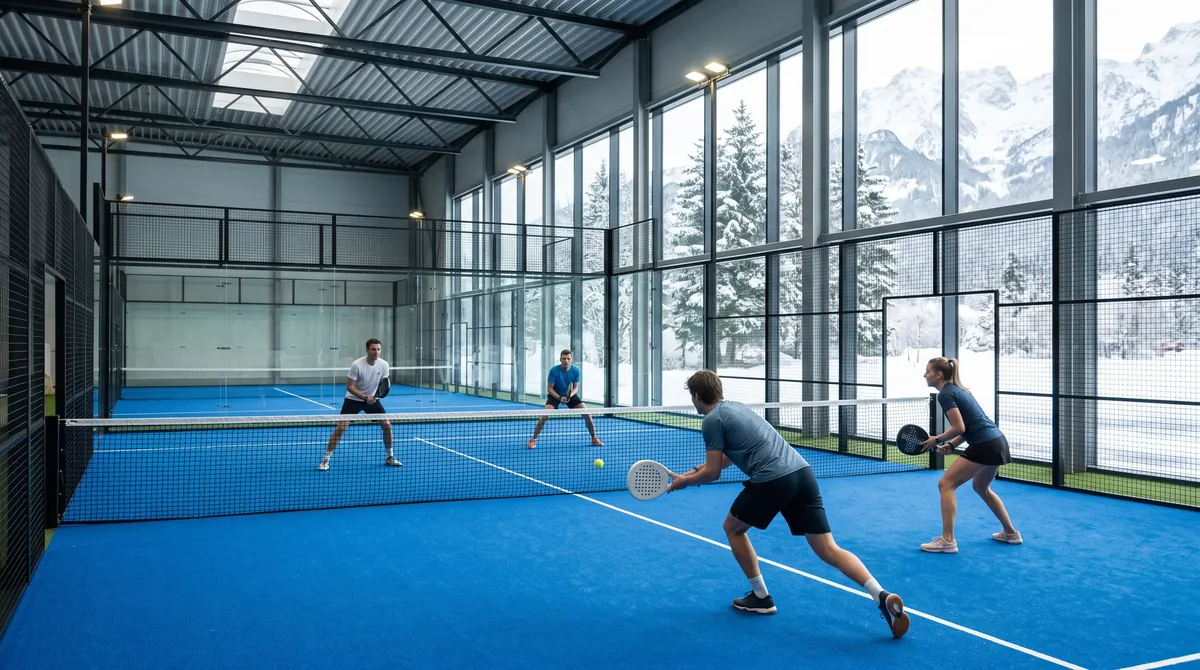
Padel was born in Mexico and grew up in Spain, where most courts stand outdoors in a warm climate. Switzerland has cold winters, rain and snow, so covered and indoor courts play a much bigger role. A hall keeps the glass dry and the bounce predictable, and it lets a club offer padel all year rather than for a summer season.
Indoor padel does feel different. Without wind and sun the ball behaves the same way in every rally, lobs are easier to judge and the returns the ball more evenly. If you learnt the game outdoors on holiday, give yourself a session to adjust to the more regular indoor rhythm.
Outdoor courts come into their own from spring to autumn, especially around the lakes and in Ticino, where the evenings are long and mild. In the mountains an outdoor court plays a touch livelier, just as a tennis court does, because the ball meets less resistance in the thin air.
Finding a game as a visitor
The easiest way to play padel in Switzerland is to book a court at a club or a padel centre and bring three friends. If you travel alone, ask about open sessions, beginner classes or a matching service for players of a similar level, which some centres offer to fill their courts.
Padel is always played as doubles, which makes it an easy game to share on a trip. Two couples, a parent with teenagers or a group of friends with mixed experience can all have a fair game, because the walls keep the ball in play and rallies come quickly, even for beginners.
Most venues rent rackets and sell balls, so you can travel light. If the game has caught you and you are thinking about a racket of your own, our Padel Racket Finder suggests a starting profile for shape, balance and weight.
- Clean indoor shoes with a padel or court sole
- A light top for cool halls and warm rallies
- A water bottle, because indoor air can be dry
- An overgrip of your own if you rent a racket
- Three friends, or the courage to join an open session
What comes next
With clubs, licences, tournaments and team competitions all growing at once, padel in Switzerland is moving from novelty to habit. For tennis players it is a sociable second game for the winter, for families an easy shared sport and for newcomers the quickest way to a real rally. Bring a little patience with the walls, and you will be playing proper points within the first hour.
Terms in this article
- Interclub
- The team competition between clubs, run in Switzerland by Swiss Tennis for both tennis and padel.
- Golden point
- At deuce a single deciding point wins the game; the receiving pair chooses which side receives it.
- Star Point
- The deuce rule of the professional tours since 2026: two advantages are played, and at the third deuce one point decides.
- Back glass
- The glass wall behind each baseline, off which the ball may be played after it has bounced.
Questions readers ask
Who runs padel in Switzerland?
Padel in Switzerland is organised by Swiss Tennis, the national tennis federation, which runs member clubs, player licences, official tournaments and an Interclub team competition for padel. The rules are those of the international padel federation FIP. For casual games you need no licence at all: you simply book a court and play with friends.
How fast is padel growing in Switzerland?
Very fast. According to the statistics of Swiss Tennis, the number of padel member clubs rose from 13 in 2024 to 52 in 2025, and player licences grew from 804 to 1,652. Official tournaments increased from 20 to 225, and Interclub went from no teams to 50. These figures count competitive players only, so the number of people playing is higher.
Can I play padel in Switzerland in winter?
Yes. Because winters are cold and wet, covered and indoor courts play an important role in Switzerland, and they let clubs and centres offer padel all year. Indoor courts have no wind or sun, so the ball behaves more evenly. Bring clean indoor shoes and book ahead, as you would for any popular indoor court.