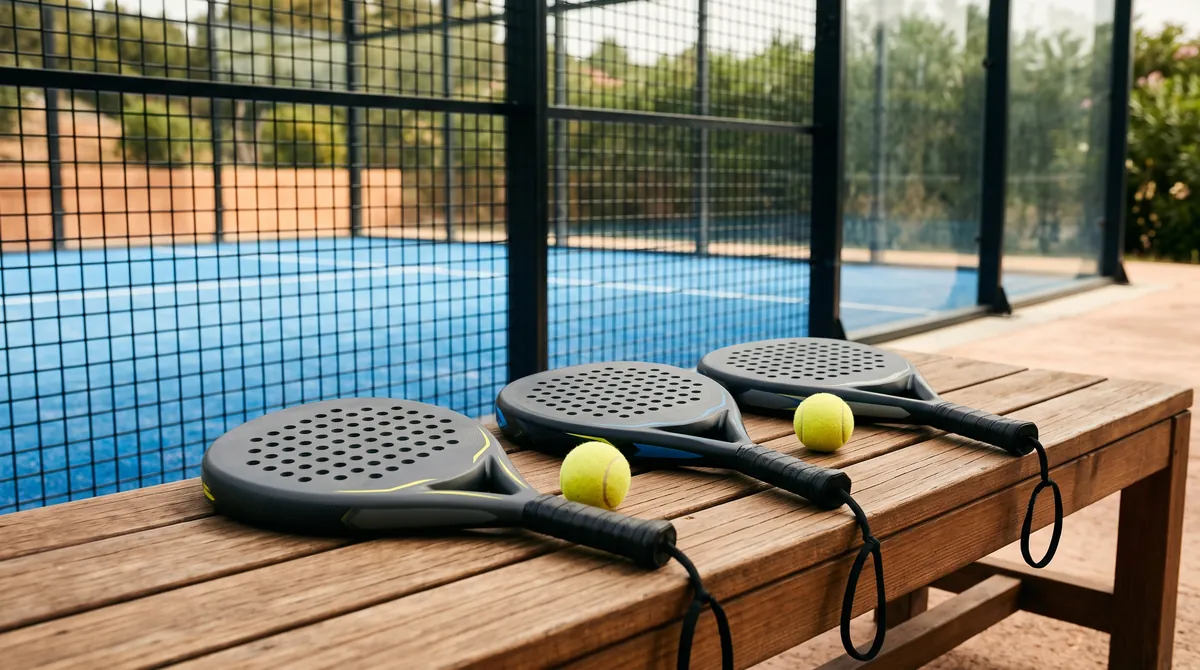



Padel rules for beginners, serve, walls and scoring in one session
The court, the underhand serve, the walls and the score. Everything you need to play your first proper padel match, based on the official FIP rules.
Padel looks like tennis played inside a glass box, and in many ways that is exactly what it is. The scoring will feel familiar to anyone who has watched tennis, the serve is gentler, and the walls keep the ball in play for longer. A handful of rules about the serve and the walls catch out almost every beginner, so here they are in plain language, based on the rules of the International Padel Federation, the FIP.
The court, the net and the four players
A padel court measures 20 metres long and 10 metres wide, measured inside the walls, and it is fully enclosed. The back walls are 3 metres of glass or solid wall topped with metal . The side walls have glass panels at each end and mesh in the middle. Service lines run parallel to the net, 6.95 metres from it, and a centre line divides the area between net and into two service boxes.
The net is slightly lower in the centre than at the sides: 88 centimetres in the middle, rising to 92 centimetres at the ends. Padel is a doubles game. The official rules are written for two pairs, and nearly every club court is built for four players.

The serve, step by step
Every point starts with an underhand serve, and this is where most first-timers need a little practice. The server stands behind the service line, between the centre line and the side wall, without touching either line with their feet. They bounce the ball on the ground in their own service area behind the line and then strike it.
At the moment of contact, the ball must be at or below waist height and the server must have at least one foot on the ground. The serve travels diagonally across the net and must bounce in the receiver’s service box. The first serve of each game goes from the right side, then the server alternates sides after every point.
After the bounce in the box, the serve may hit the glass and stay in play. But if it bounces in the box and then hits the mesh before bouncing a second time, it is a fault. A serve that clips the net and lands in the correct box is replayed, unless it then hits the mesh. As in tennis, you have two serves, and two faults lose the point.
The receiver must let the serve bounce before hitting it. Volleying the serve, or being hit by it before it bounces, loses the point.
How the walls work
The walls are what make padel padel, and one principle covers most situations: the ball must bounce on the ground in your opponents’ half before it touches any of their walls or mesh. If your shot flies straight into their glass without bouncing first, you lose the point.
Once the ball has bounced on your side, it may hit your back glass, your side glass or both, and you can still play it before it bounces a second time. You may also hit the ball into your own glass walls so that it rebounds over the net, a useful escape when you are under pressure, as long as it then lands in the opponents’ court. There is one important exception: if your shot touches the mesh on your own side, you lose the point.
- Ball bounces in your half, then hits your glass: still in play.
- Your shot hits the opponents’ glass before bouncing: point lost.
- You play the ball into your own glass and it goes over: allowed.
- Your shot touches the mesh on your own side: point lost.
- The ball touches your body or clothing: point lost.
On courts with enough safe space and open exits, players may run outside the court to retrieve a ball that has bounced and left the enclosure, then play it back. This is only allowed where the court meets the safety requirements, so check before your first match. You also lose the point if you or your racket touch the net or the opponents’ side while the ball is in play.
Scoring, from 15 to the Star Point
Points are counted as in tennis: 15, 30, 40 and game. A set goes to the first pair to win six games with a lead of two, and at six games all a to seven points, with a two point margin, decides the set. Matches are usually the best of three sets, and pairs change ends after the first, third and every following odd game.
The rules allow three ways to settle a game at 40 all. With traditional advantage, you need two points in a row. With the , a single deciding point is played at the first deuce, and the receiving pair chooses whether to receive on the right or the left. It is popular in club play because it keeps matches moving.
Since 2026 the FIP’s professional circuits, including Premier Padel, use the . Two advantage points are played as normal, and if the game returns to deuce a third time, a single deciding point is played, again with the receivers choosing the side. Before a social match, simply agree which version you are playing. If you tend to lose track of the score, our Score Keeper can count it for you.
Common beginner mistakes
Nearly everyone makes the same few errors in their first sessions, and knowing them in advance saves a lot of lost points.
- Serving too hard: a steady, placed serve wins more points than a fast one that ends in the mesh.
- Hitting the ball straight into the opponents’ glass: aim for the ground first.
- Standing with your back to the glass: give the ball room to come off the wall.
- Volleying the return of serve: always let the serve bounce.
- Forgetting the wrist cord: the rules require it, and a dropped racket loses the point.
Terms in this article
- Service line
- The line 6.95 metres from the net behind which the server stands and bounces the ball.
- Mesh
- The metal fencing around parts of the court; rebounds from it are irregular and it has its own rules.
- Tie-break
- A game played at six games all, won by the first pair to reach seven points with a two point lead.
- Golden point
- A single deciding point played at the first deuce, with the receiving pair choosing the side.
- Star Point
- A deciding point played after two advantages, used on the FIP and Premier Padel tours since 2026.
Questions readers ask
Can I hit the ball against my own walls?
Yes. Once the ball has bounced on your side it may come off your glass and you can still play it. You may also hit the ball into your own glass so that it rebounds over the net, as long as it then bounces in the opponents’ court. The exception is the mesh: if your shot touches the mesh on your own side, you lose the point.
Is the golden point still used?
Yes. The golden point remains one of the scoring options in the FIP rules and is widely used in club and social matches because it keeps games short. Since 2026 the FIP and Premier Padel tours use the Star Point instead, which allows two advantages before a deciding point. In friendly play, just agree on the format before the first serve.