


The tennis serve, from a reliable toss to an easy second serve
The serve is the one shot you control completely. Build it step by step, from the continental grip and a steady toss to a second serve you can trust at 30-40.
The serve is the only shot in tennis where nobody else decides what happens before you hit. That makes it the best shot to practise alone and the most frustrating one to get wrong. Most club players do not need a faster first serve; they need a toss that goes to the same place every time and a second serve that lands when the score is tight. Here is how to build both, one piece at a time.
Grip and stance
Almost every coach teaches the serve with the , the one you would use to hold a hammer with the edge of the racket facing the target. It feels awkward at first, because a beginner’s instinct is to hold the racket like a frying pan and push the ball flat into the box. That forehand grip works for gentle serves, but it blocks the wrist and forearm action that creates spin and easy pace later on.
Change gradually. Start with short serves from the service line using the continental grip, then move back to the baseline as the contact starts to feel natural. A few weeks of slightly odd serves is a fair price for a motion that will keep improving for years.
Stand sideways with your front foot angled towards the net post and your back foot parallel to the baseline. From there, players use one of two patterns. In the platform stance the feet stay apart throughout; in the pinpoint stance the back foot slides up next to the front foot before you push up. Both are sound, so choose the one that feels balanced and repeatable.
The toss, the foundation of everything
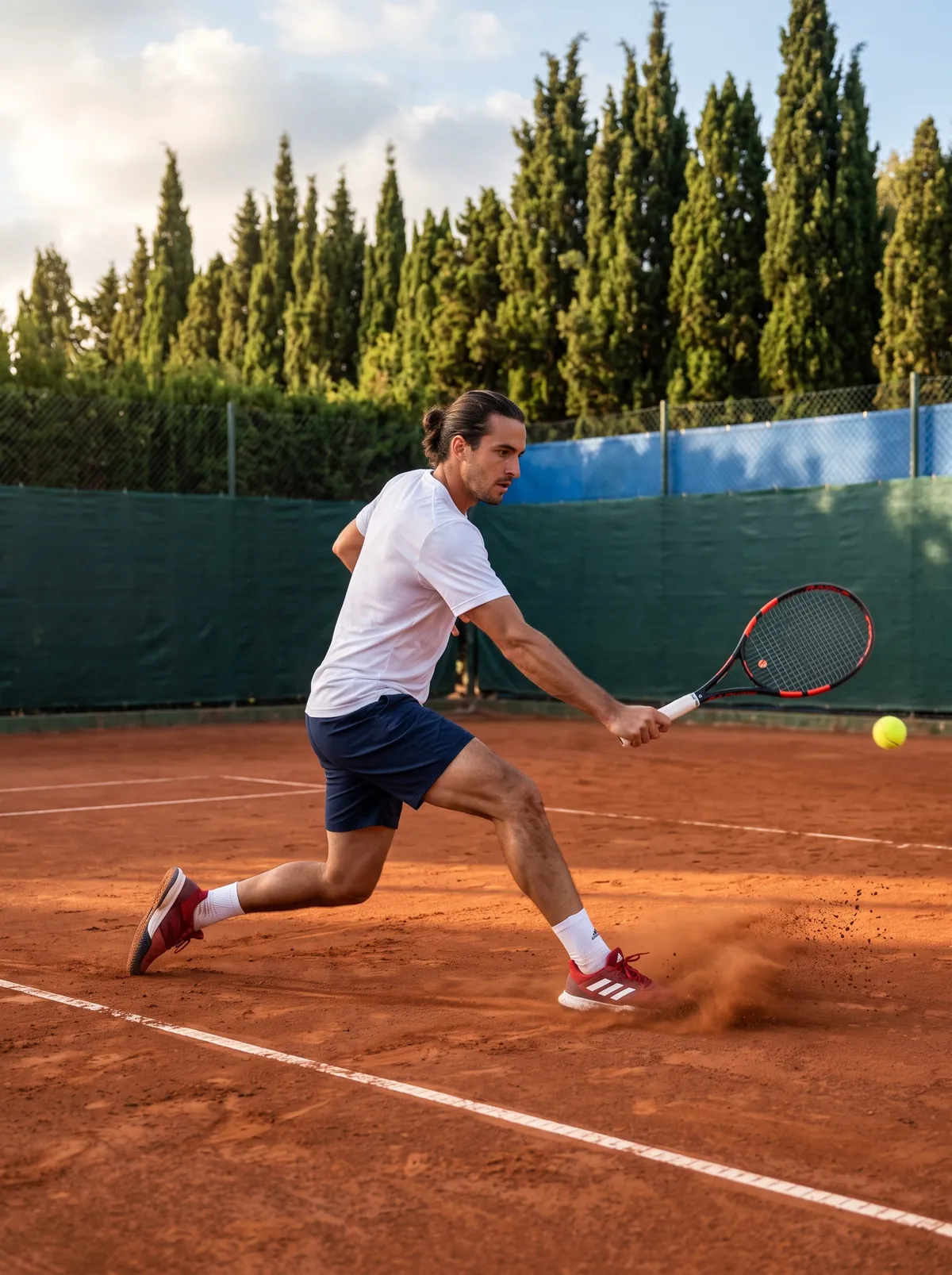
If the toss wanders, the rest of the serve has to chase it. Hold the ball lightly in your fingertips, not in the palm, and lift with a straight arm from the shoulder. Release around head height and let the arm keep rising after the ball leaves your hand. The wrist and elbow should stay quiet; flicking them is the most common cause of a toss that drifts.
For a flat or sliced serve, the ball should rise a little higher than you can reach with the racket and sit slightly in front of you and towards your hitting side. Test it without hitting: toss and let the ball drop. It should land just inside the baseline, a little in front of your front foot. If the toss is poor, you are allowed to let it drop or catch it and start again; under the ITF rules that is not a fault.
If the toss wanders, the rest of the serve has to chase it.
From trophy position to follow-through
Once the toss is steady, the motion links together in a sequence. Think of it as a chain that starts at the ground and finishes at the racket head.
- Toss and bend: as the tossing arm rises, the knees flex and the hitting arm lifts the racket up behind you.
- : tossing arm pointing up at the ball, hitting elbow at about shoulder height, racket pointing up, body still sideways.
- Racket drop: push up with the legs and let the racket fall loosely behind your back. A relaxed grip makes this happen on its own.
- Swing up to the ball: reach up and hit at full extension, slightly in front of you, with the edge of the racket leading.
- : through contact the forearm turns so the strings face the target, which is what squares the racket on a continental grip.
- Follow-through: let the racket finish across the body on the opposite side, and step into the court with the back foot to land balanced.
Power comes from the legs and the turn of the trunk, not from the arm. If your shoulder does all the work, the serve tends to be slow and tiring. When the sequence is right, it feels easier than it looks.
First serve and second serve
You get two chances. Two faults in a row is a double fault, and you lose the point. A serve that clips the net and lands in the correct box is a let and is simply played again, without cancelling a previous fault. That rule shapes the strategy: the first serve can take more risk, the second must go in.
A reliable second serve uses spin rather than caution. Slowing the arm down is the classic mistake, because a hesitant swing loses both pace and control. Instead, keep the swing speed and brush up and across the back of the ball. The slice serve curves away to the side; the uses more upward brushing, with the toss a little further over your head, so the ball clears the net with height and dips into the box. Both give you a margin that a flat second serve never has.
Watch your feet as well. Under the ITF rules you must stand still behind the baseline before you start, and during the motion you may not touch the baseline or the court with either foot, walk or run, or cross the imaginary extensions of the centre mark or the sideline. A counts as a fault, so a lovely second serve with the toe on the line is still a double fault.
A practice routine and a healthy shoulder
A basket of balls and an empty court will do more for your serve than any match. Place two targets in each service box, such as towels or cones, one wide and one down the middle. Then work through the session in order:
- Ten tosses without hitting, checking where the ball lands.
- Ten easy serves from the service line with the continental grip.
- Twenty serves from the baseline, alternating the deuce and advantage boxes.
- Twenty second serves with spin, counting how many land.
- Finish by playing out points that start with a second serve only.
Under pressure, a routine is your friend. Bounce the ball the same number of times, take a breath and picture the target before every serve. It gives your mind something calm to do instead of replaying the last double fault.
Terms in this article
- Continental grip
- The grip used for the serve and volleys, held like a hammer with the racket edge facing the target.
- Trophy position
- The loaded moment of the serve with tossing arm up, hitting elbow raised and racket pointing up behind the head.
- Pronation
- The inward turn of the forearm through contact that squares the strings to the target on a continental grip.
- Kick serve
- A spin serve brushed upwards that clears the net with height, dips into the box and bounces up.
- Foot fault
- A service fault caused by illegal foot movement or position, such as touching the baseline during the motion.
Questions readers ask
Should I use a platform or a pinpoint stance?
Both are used successfully at every level. In the platform stance your feet stay apart, which many players find simpler and more stable. In the pinpoint stance the back foot slides up to the front foot, which can help some players push up more strongly. Try each for a few sessions and keep the one that lets you toss, load and land in balance without thinking about your feet.
How can I stop double faulting under pressure?
Build a second serve with spin and practise it far more than your first serve. Keep a full, relaxed swing rather than slowing down, because a tentative arm loses control. Use the same short routine before every serve, choose a clear target and aim for height over the net. In matches, a second serve that lands deep in the box with spin is worth more than an occasional ace.
Is the serve bad for the shoulder?
For healthy players with sound technique and sensible volume, serving is a normal part of the game. Problems tend to come from doing too much too soon or serving with the arm alone. Warm up, let the legs and trunk create the power, and increase practice gradually. Persistent shoulder pain belongs with a doctor or physiotherapist, so get it checked rather than playing through it.