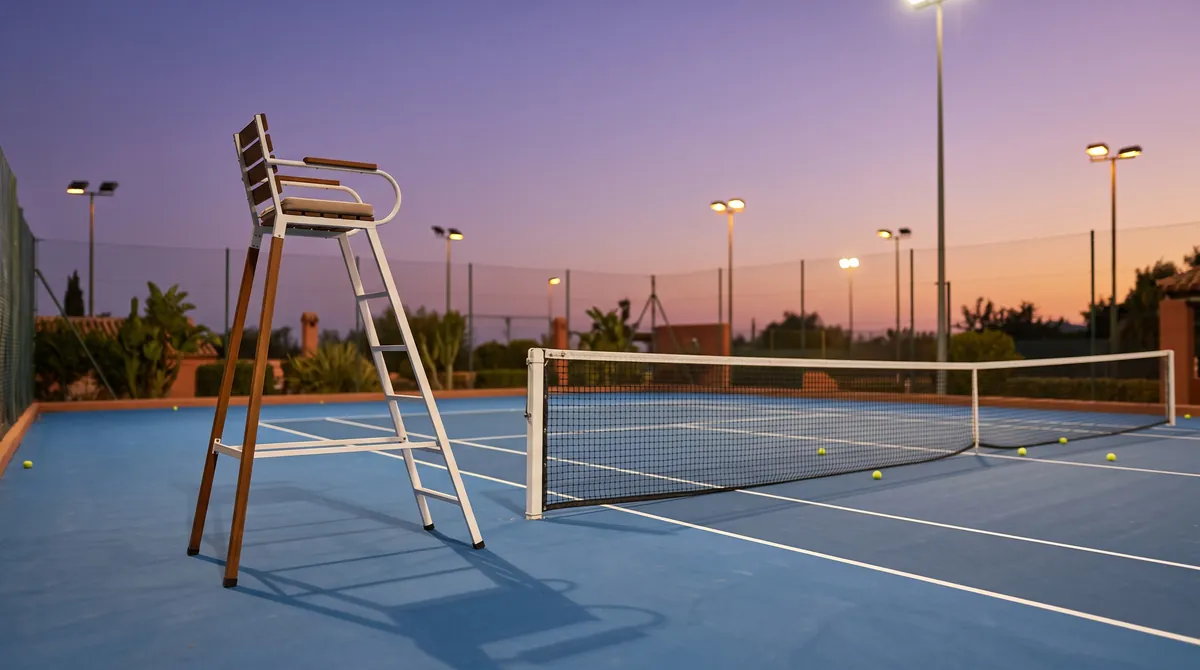



Doubles tennis positioning, where to stand and when to move
Good doubles is mostly geometry and conversation. Where each of the four players should stand, how to move as a pair, and drills that make club doubles click.
Most club tennis is doubles, yet many players simply stand where they stood last week and hope for the best. Doubles rewards a different set of skills from singles: angles, timing at the net and a partner you talk to. You do not need a big serve to win more matches. You need to know where to stand, when to move and who takes the ball down the middle.
The starting positions
The classic set up is one up, one back. The server stands behind the baseline, usually wider than in singles, halfway or so between the centre mark and the doubles sideline. The server’s partner stands at the net in the other half of the court, roughly in the middle of the service box and a little closer to the net than to the service line.
On the other side, the returner stands near the baseline where they can reach a wide serve and a serve down the middle. The returner’s partner usually starts on or just inside the service line in the other half, facing the opposing net player. Their first job is to watch that net player, because a volley from there will come straight at them.
The rules decide who stands where at the start. At the beginning of each set, the serving pair chooses which partner serves first and the receiving pair chooses which partner receives in each half of the court. Those choices stay fixed until the end of the set.

The net player’s job
The player at the net has the best chance to finish the point, and also the easiest chance to watch it pass by. Stay on your toes, racket up in front of you, and shift with the ball. When your partner hits cross court, move slightly towards the middle, because that is where the reply is likely to come.
A is when the net player crosses to intercept a ball that was heading towards their partner. The best moment is just as the opponent commits to a cross court shot. Move diagonally forwards, not sideways, and volley towards the gap between the opponents or at the feet of the player closest to the net. Your partner must then cover the side you left, so agree in advance how often you will go.
Middle balls cause more lost points than any clever shot.
Moving as a pair
A useful picture is that you and your partner are tied together with a rope about three metres long. When one of you is pulled wide, the other moves across to cover the middle. When one moves forwards to the net, the other should follow or at least stop retreating. Large gaps open when partners move in different directions.
Middle balls cause more lost points than any clever shot. Settle a simple rule before you start: often the player with the forehand in the middle takes it, or the player who is further forward. Then talk. A short call of “mine”, “yours” or “switch” is worth more than a perfect volley.
Lobs follow the same logic. If a lob goes over the net player, the partner at the back usually crosses to chase it, and the net player switches to the other side. Call “switch” early so you both know. If you are both at the net and the lob is good, the player on the side of the ball can often take it with an overhead before it bounces.
Formations and when to use them
Once one up, one back feels natural, try the alternatives. Each one solves a specific problem.
- Both at the net: the strongest position in doubles. Pairs who reach the net together control the point and force the opponents to lob or hit low.
- Both back: a defensive option against a powerful serve or a dominant net player. It buys time and sets up lobs.
- : the server’s partner stands at the net in the same half as the server, and the server moves across after serving. It takes away a returner’s favourite cross court reply.
- : the net player crouches close to the centre line and moves left or right after the serve. It keeps the returner guessing and suits pairs who like to poach.
Many pairs use simple hand signals behind the back to say whether the net player will cross or stay. Keep them few and agreed in advance; a signal that confuses your partner does more harm than none.
From tennis doubles to padel, and drills to try
If you also play padel, much of this will feel familiar. Padel is always played as doubles, the pair moves as one, the net is the position to win, and the lob is the main way to take it from your opponents. The walls change the defence, but the idea of covering the middle and talking constantly transfers directly. If you are deciding which game suits you, our Sport Match quiz compares all three.
For club doubles, a few regular drills make more difference than any tactic you read. Try these with four players and a basket of balls:
- Two up against two back: the net pair volleys, the baseline pair rallies and lobs. Swap roles every five minutes.
- Poach timing: the coach or a feeder sends cross court balls and the net player crosses on a call.
- Middle ball rule: feed balls down the centre and let the pair practise calling “mine” and “yours” out loud.
- Lob and switch: lob over the net player and practise the cross and switch until it happens without thinking.
- Serve plus one: play points in the Australian formation so the server learns where to move.
Terms in this article
- Poach
- When the net player crosses to intercept a ball that was heading towards their partner.
- Australian formation
- A serving formation in which the server’s partner stands at the net in the same half as the server.
- I formation
- A serving formation in which the net player crouches near the centre line and moves after the serve.
- Tramlines
- The side strips between the singles and doubles sidelines, called the alley in North America, in play in doubles.
Questions readers ask
Who should take a ball down the middle in doubles?
Agree a rule before the match so you never both leave it. A common choice is that the player with the forehand in the middle takes it, or the player who is closer to the net, because they can volley it earlier. Whatever you choose, call the ball out loud with a short “mine” or “yours”. Clear communication matters more than which rule you pick.
When should we use the Australian formation?
Use it when the returner keeps hurting you with the same cross court reply, often a strong forehand or backhand return angled past the server. By putting the net player in the same half as the server, you block that angle and force the return down the line. It can also unsettle a returner who likes rhythm. Practise the server’s movement first, because the server must cover the open side.