

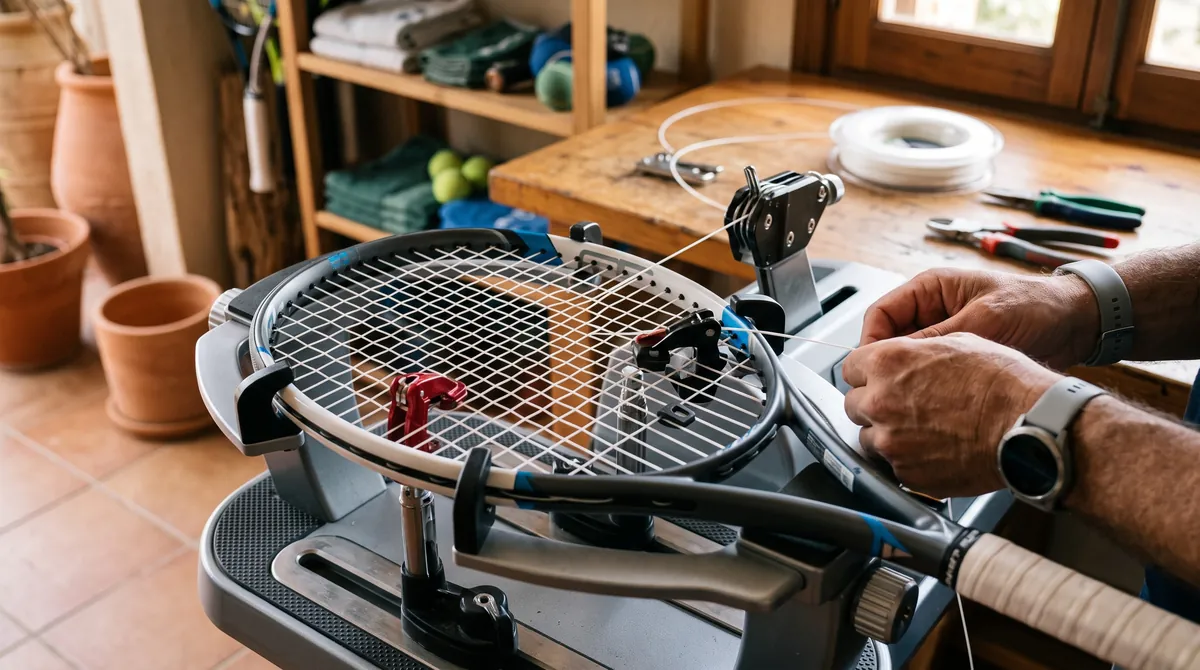

Tennis strings and tension, how the bed changes every shot
Strings are the only part of the racket that touches the ball. How string type, gauge and tension shape power, control, spin and comfort, and when to restring.
Players spend weeks choosing a racket and minutes thinking about the strings, yet the strings are the only part that touches the ball. Change the string type or the tension and the same frame can feel livelier, more controlled, softer or harsher. Understanding the is the cheapest way to make your racket suit you.
What the string bed does
When the ball hits the strings, the string bed deflects like a small trampoline and then springs back, returning energy to the ball. The more the bed gives, the more power it returns and the softer the impact feels. The strings also grip the ball for a moment and, with many modern strings, slide and snap back into place, which adds spin.
The strings running from the tip of the head to the throat are the , those running across are the . A frame’s string pattern tells you how many of each there are. An open pattern such as 16 by 19 lets the strings move more, for spin and power, while a dense pattern such as 18 by 20 feels firmer and more controlled.
Many rackets are sold already strung with a basic string at a middle tension. That is fine to start with, but it is rarely the best match for your swing, and it is the first thing worth changing once you play regularly.
Four families of string
Natural gut, made from animal intestine, is the most elastic string you can buy. It feels soft and lively, holds its tension well and is very comfortable, but it costs the most and does not like moisture.
Multifilament strings are made from many fine fibres twisted together and are designed to come close to the feel of gut at a lower price. They are comfortable and powerful, and a sensible choice for players with sensitive arms, though they can fray and wear through faster.
Synthetic gut is the classic all-rounder: a solid nylon core with outer wraps, inexpensive and reasonably durable. For many club players it is perfectly adequate.
Polyester, often called poly, is stiff and durable and produces plenty of spin and control for players with fast swings. The price is comfort: it is firm on the arm and loses its elasticity relatively quickly, so it can feel dead long before it breaks.
A combines two strings, typically polyester in the mains for spin and durability with gut or multifilament in the crosses for feel. Thickness, called , matters too. A 16 gauge string is around 1.30 mm and a 17 gauge around 1.20 to 1.25 mm; thinner strings bite the ball more and feel crisper, thicker ones last longer.
Which family suits you depends more on your swing and your arm than on your level. Players with compact, flatter strokes often enjoy multifilament or synthetic gut, while players with long, fast swings and heavy topspin tend to prefer polyester or a hybrid.
Tension, power and control
Tension is measured in kilograms or pounds. Most frames have a recommended range printed inside the throat or on the frame, and for most club players the useful window lies roughly between 20 and 27 kg (about 44 to 60 lb). As a general pattern, gut and nylon based strings are often strung at around 22 to 27 kg (50 to 60 lb), and polyester a few kilograms lower.
The basic rule is simple. Lower tension gives more power and comfort, because the bed deflects more. Higher tension gives more control, because the ball leaves the strings with less speed, but the racket feels firmer and less forgiving. If your shots keep flying long, a little more tension can help; if the ball feels dead and your arm tired, try less.
Change tension in small steps of about 1 kg (2 lb) and change only one thing at a time, so you know what made the difference. Note string type, gauge and tension each time you restring.
Tension loss and when to restring
Strings start losing tension the moment they come off the stringing machine, with a noticeable drop over the first day and a slower decline afterwards. Polyester in particular loses its liveliness with play, so a string bed that has not broken may still be well past its best.
A common rule of thumb is to restring as many times a year as you play per week: three times a week means three restrings a year. Players using polyester, or those who hit hard with lots of spin, often restring more often. Signs that it is time include strings that slide out of place and do not snap back, a duller sound, and shots that suddenly fly long or lack bite.
Comfort, arm care and the grip
If your arm feels sensitive, the string bed is the first place to look. Softer strings such as multifilament or gut, a slightly lower tension and avoiding stiff polyester strung tight all reduce the shock that reaches the forearm.
Grip size matters just as much. A grip that is too small makes you squeeze to stop the racket twisting, and one that is too large makes it hard to relax and rotate the forearm. Sizes run from L0 to L5, which correspond to 4 to 4 5/8 inches around the handle. Our Grip Size Finder helps you measure yours, and remember that an overgrip adds a little thickness.
Kit can only do so much. If elbow or forearm pain persists despite changes to strings and grip, see a doctor or physiotherapist rather than playing through it.
Terms in this article
- String bed
- The woven surface of strings inside the racket head that makes contact with the ball.
- Mains
- The strings running lengthwise, from the tip of the head down to the throat.
- Crosses
- The strings woven across the mains from one side of the head to the other.
- Gauge
- The thickness of a string; a higher gauge number means a thinner string.
- Hybrid
- A string job using two different strings, usually one in the mains and another in the crosses.
Questions readers ask
What string tension should I use as a club player?
Start in the middle of the range printed on your frame, which for many rackets falls somewhere around 22 to 27 kg (50 to 60 lb). String polyester a little lower than gut or nylon based strings. Then adjust in steps of about 1 kg: more tension if the ball flies long, less if it feels dead or harsh.
How often should I restring my tennis racket?
A common rule of thumb is as many times a year as you play per week. If you play twice a week, restring about twice a year. Players who use polyester or hit with heavy spin usually need to restring more often, because polyester loses its liveliness well before it breaks.
Which strings are kindest to the arm?
Natural gut and multifilament strings are the softest and most elastic, especially at a moderate tension. Stiff polyester strung tight is the harshest combination. If your arm is sensitive, combine soft strings with the right grip size, and see a doctor or physiotherapist if pain persists.