

Golf club fitting, what happens and who benefits
A fitting matches length, lie, loft and shaft to the way you swing. What happens in the bay, why mid handicappers gain as much as low ones, and when to go back.
Clubs off the shelf are built for an average golfer who does not exist. A fitting adjusts length, lie, loft, shaft and grip to your body and your swing, so the club works with you rather than against you. It is not a luxury reserved for scratch players. Often it helps most those who are still learning to find the middle of the face.
Static measurements, the starting point
Most fittings begin with a tape measure. The fitter notes your height and your wrist to floor distance, measured while you stand upright in golf shoes with your arms hanging relaxed. Together they suggest a starting length and . Hand size and finger length give a first idea of grip size.
These numbers are only a starting point. Two golfers of the same height can need different clubs because their posture, arm length and swing differ. That is why a fitting moves on quickly to hitting balls.
A good fitter will also ask questions before you hit a shot: what you play now, what your usual miss is, how often you play and what you want from new clubs. More distance, a straighter driver, higher iron shots and more consistent contact are different goals, and they lead to different answers.

Dynamic fitting with a launch monitor
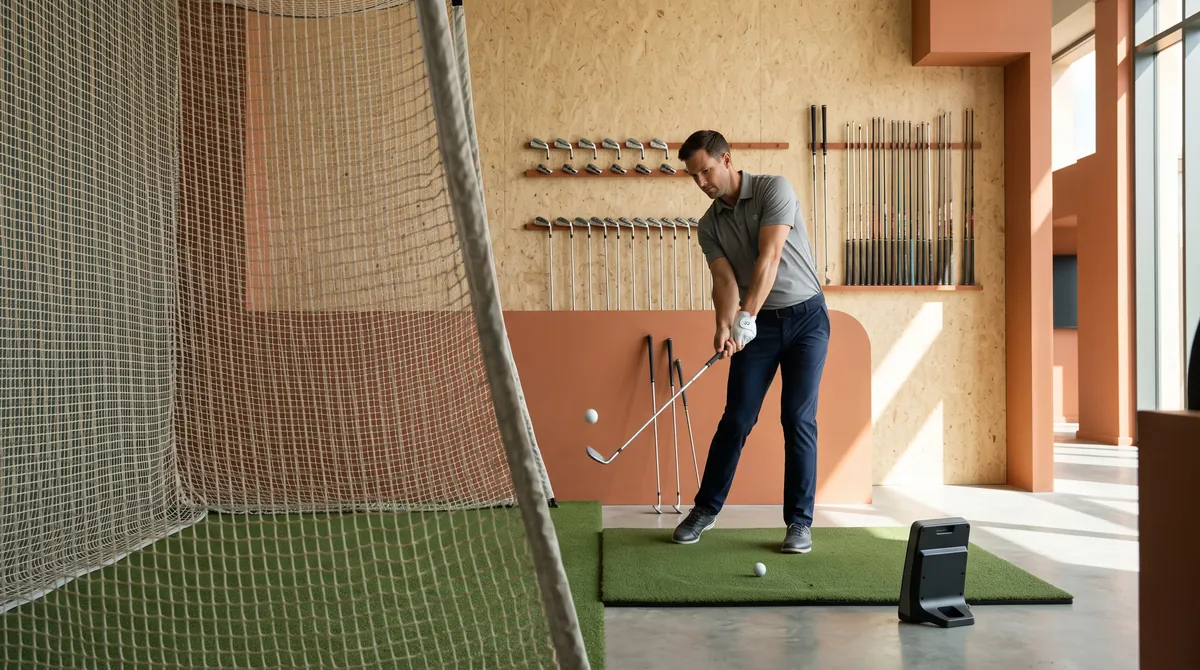
The heart of a modern fitting is the , a radar or camera system that measures every shot. The key numbers are club speed, ball speed, launch angle, spin rate and carry distance, along with , the spread of your shots left and right and long and short.
A good fitter is looking for a pattern, not one perfect strike. After a warm-up you hit a series of shots with your own club as a baseline, then with different heads and shafts. The aim is the combination that gives the best mix of distance and consistency for your swing, which is often not the longest single hit of the session.
A good fitter is looking for a pattern, not one perfect strike.
Fittings take place indoors on mats or outdoors on grass. Outdoors you see the real ball flight, indoors you get a calm, controlled bay. Both work, as long as the fitter explains the numbers in plain language. Ask which ball is being used, too: premium balls spin differently from many of the balls club golfers play, so if you always use one type, bring a few.
Shaft, length, lie and loft
describes how much the shaft bends during the swing, from flexible to extra stiff. As a general pattern, faster and more aggressive swings suit stiffer shafts, while smoother, slower swings suit softer ones. Shaft weight matters as much as flex: too light and your timing can feel loose, too heavy and you tire over 18 holes.
Length affects where you strike the face, and a club that is too long or too short tends to push contact towards the heel or the toe. The lie angle is the angle between the shaft and the sole. If it is too upright for you, the toe points up at impact and the ball tends to start left of target for a right-handed golfer; too flat, and it tends to go right. Fitters check this with impact tape or a lie board.
means spacing the lofts so that each club gives a useful step in distance, without two clubs that go the same way or a big hole between them. It matters most at the ends of the bag, among long irons, hybrids, fairway woods and wedges. With a limit of 14 clubs under the Rules of Golf, every slot should earn its place.
Wedges deserve their own look. The bounce, the curved sole that stops the club digging in, should suit your swing and your courses: more bounce for steep swings and soft ground, less for shallow swings and firm turf. Grips complete the picture. A grip that is too thin or too thick can make your hands tense or restrict how freely the club releases, and it is one of the cheapest things to change.
Who benefits, beginners included
Better players notice small changes, but some of the biggest gains come further down the handicap range. A mid handicapper with irons that are too flat or a shaft that is too stiff spends every round fighting the equipment, and slowly builds compensations into the swing.
Players with slower swing speeds, whether through age, build or simply experience, often benefit from lighter shafts and more loft, which help the ball into the air. Anyone playing a set designed for a much taller or shorter person also gains quickly.
For a complete beginner, a short fitting for length, lie and shaft flex is usually enough. The swing changes fast in the first year, so a full fitting makes more sense once your strike becomes repeatable. Our Handicap Calculator is a good way to watch that progress before you decide.
Booking, preparing and refitting
Bring the clubs you use now, your golf shoes and glove, and an honest description of your usual misses. Arrive warmed up, or ask for time to hit a few balls first, and avoid booking straight after a hard round when you are tired.
A fitting for the driver or a set of irons alone usually takes about an hour, while a full bag can take two to three hours and is sometimes split over two visits. Some fitters charge a fee that is credited if you buy, others build it into the price of the clubs. Either way, ask for your full specification in writing, so you can decide in your own time.
Fitting and buying are separate decisions. Your specification lets you buy new clubs, have your current set adjusted where the heads allow it, or simply change grips. Consider a refit when your swing speed changes, after a series of lessons that reshape your swing, after an injury, or when your ball flight no longer matches the numbers. For many club golfers that means every few years rather than every season.
Terms in this article
- Launch monitor
- A radar or camera system that measures club and ball data such as speed, launch angle, spin and carry.
- Lie angle
- The angle between the shaft and the sole of the club when it rests on the ground.
- Loft gapping
- Spacing the lofts in a set so each club gives a useful, even step in distance.
- Shaft flex
- How much a shaft bends during the swing, from flexible to extra stiff.
- Dispersion
- The spread of a series of shots, left and right as well as long and short.
Questions readers ask
Is club fitting worth it for a high handicapper?
Often yes, especially for the basics. Clubs with the wrong length, lie or shaft flex force you to compensate, and those compensations become habits. A short fitting covering length, lie and shaft is usually enough for a beginner, with a fuller fitting once your strike becomes more repeatable.
Do I have to buy clubs after a fitting?
No. A fitting is advice, and a good fitter will give you your specification in writing whether or not you buy on the day. Some fitters charge a fee that is credited against a purchase, others include it in the club price. Ask how it works when you book, so there are no surprises.
How often should I get refitted?
There is no fixed schedule. A refit makes sense when your swing speed or swing changes noticeably, after an injury, or when your ball flight no longer matches your numbers. For many club golfers that works out at every few years. Lie angles on softer irons can also drift with use and are worth checking now and then.