


Planning a golf holiday, seasons, tee times and the clubs question
When to go, how much golf to book, what a green fee covers and whether your clubs should fly with you. A calm plan for a trip that leaves room for life off the course.
A good golf holiday is not the one with the most rounds. It is the one where the weather suits the game, the tee times are booked, nobody spends half the day in a car and the clubs arrive in one piece. A little planning in the right order takes care of almost all of it, and it leaves room for the people who came along for the sun rather than the golf.
Choose the season before the place
Most golf destinations have a sweet spot of a few months, and outside it the same course can feel like a different place. Start with the month you can travel, then pick the region that is at its best in that month, not the other way round.
The Algarve and Andalusia are at their most comfortable in spring and autumn, with mild days, firm fairways and enough light for a relaxed round. High summer brings real heat, especially inland, and winter is mild but shorter and can be wet. Mallorca follows a similar pattern.
Scotland and Ireland come into their own from late spring to early autumn. In midsummer, daylight in Scotland stretches to around 17 hours, so a round after dinner is entirely possible. Wind and rain can arrive in any month, which is part of the character of links golf, so pack waterproofs whatever the forecast says.
The Gulf works the other way round. Its golf season runs through the cooler months, roughly from late autumn to early spring, while summer temperatures regularly climb above 40 °C and push play into the first hours after sunrise.
The Season Planner on our travel page shows the best months by region at a glance, which makes it easier to match your holiday window to a destination.

How much golf makes a good week
Enthusiasm at the booking stage is the classic trap. Thirty-six holes a day sounds wonderful in January, but by the third day your back, your hands and your patience will disagree. For most club golfers one round a day is the right rhythm, with the rest of the day for food, a swim or a short practice session.
For a seven night trip, four or five rounds is plenty. Leave one day in the middle completely free, so tired legs recover and a day of bad weather does not wreck the plan. A nine hole loop in the evening is a lovely extra if you still feel fresh.
If your partner does not play, choose a base with a beach, an old town to explore or good walking nearby. Early tee times then leave the afternoons for shared plans, and a rest day becomes a day out together rather than a day lost.
Look hard at travel time between courses. A region with several courses within half an hour of your base beats a grand tour with long transfers every morning. If you want to see two areas, split the stay between two bases rather than driving two hours to every .
Tee times, green fees and handicap certificates
A tee time is the slot when your group starts, and in high season the best ones at popular courses go early. Book the rounds that matter most first, ideally when you book the flights, and fill the other days later. Morning slots are the most sought after in hot regions, while late afternoon times are often cheaper.
The is simply the charge for a visitor to play one round. Check what it includes: a , range balls and a locker are sometimes part of the price and sometimes extra. Packages with several rounds can make sense if you are staying in one region.
Some courses ask visitors to show proof of handicap, and a few of the best known set a maximum. Under the World Handicap System your is recognised across borders, so keep a digital record or a certificate from your club or national association to hand. Our Handicap Calculator shows how many strokes your index gives you on a course you do not know yet.
If you do not have an index yet, choose courses that welcome newer players. Dress codes and local rules vary too, and a quick look at the course information before you travel avoids awkward moments at the first tee.
Buggies, trolleys and caddies
In Spain, Portugal and the Gulf the buggy, the small electric cart known in North America as a golf cart, is part of the experience. On hilly resort courses with long distances between green and tee it is often strongly advised, and in some places it is included in the green fee. Ask whether buggies are kept to the paths after rain.
On the links of Scotland and Ireland walking is the norm, and buggies can be limited or reserved for players with a medical reason. A pull trolley or an electric trolley is usually available for hire. Many of the better known links also offer caddies, who carry the bag, read the greens and know where the wind will take the ball. Book one in advance, and ask locally what is customary for a tip.
Your own clubs or rented ones
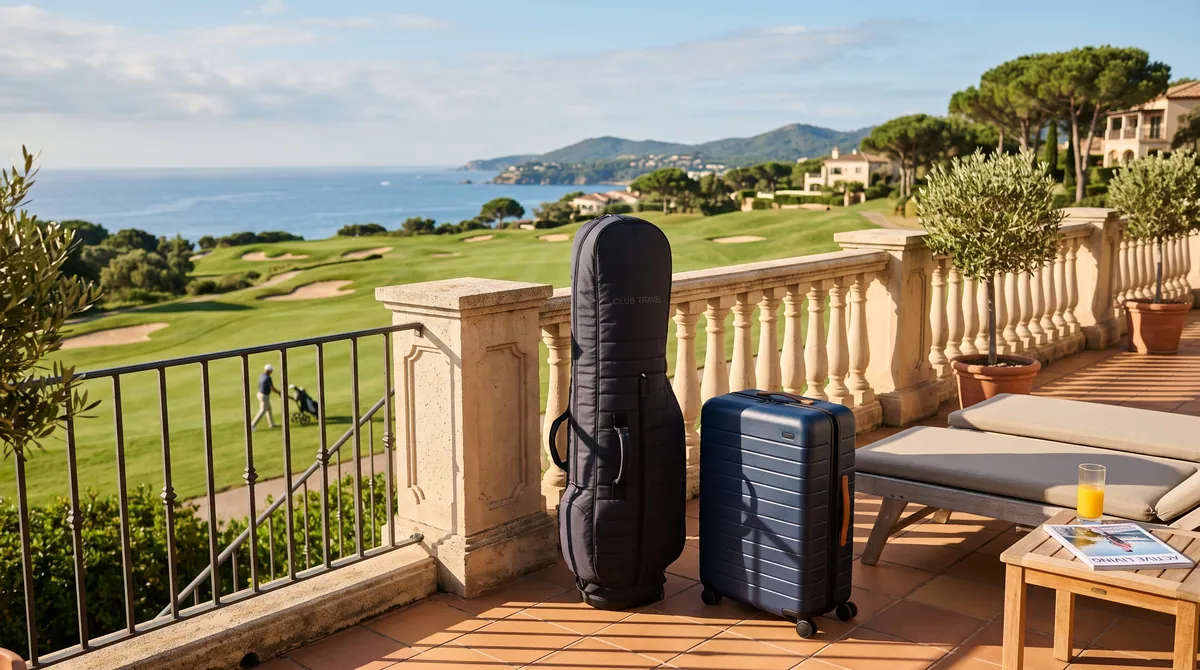
Your own clubs give you familiar distances, the right length and lie, and one less thing to think about on the first tee. The price is a bulky bag, a sports equipment fee with many airlines and a car big enough to carry it. Rules for golf bags differ from carrier to carrier, so check before you book rather than at the check-in desk.
Rental sets solve the luggage problem, but quality varies widely. Ask what you will get: current or tired clubs, men’s or women’s lengths, and whether left-handed sets are available, as these can be scarce. Even if you rent, bring your own shoes, glove and favourite balls, which matter more than most golfers expect.
A simple rule works for most trips. For a long weekend with two rounds, renting is usually the calmer choice. For a week with four or more rounds, your own clubs are worth the trouble.
Start with the month you can travel, then pick the region that is at its best in that month.
- Waterproof jacket and trousers for links trips
- Sun hat, sunscreen and a refillable water bottle for the south
- Golf shoes that are already broken in
- Proof of handicap, digital or on paper
- Two gloves, so one can dry while you wear the other
Terms in this article
- Tee time
- The booked starting slot for your group on the first tee.
- Green fee
- The charge for a visitor to play one round on a course.
- Handicap Index
- Your measure of playing ability under the World Handicap System, recognised by courses in other countries.
- Buggy
- A small electric cart for two players and their bags, called a golf cart in North America.
- Twilight
- A late afternoon tee time, often sold at a lower price, which may not leave daylight for all 18 holes.
Questions readers ask
How many rounds of golf should I plan for a week away?
For most club golfers four or five rounds in seven nights is plenty. One round a day keeps the game enjoyable, and a free day in the middle lets your body recover and gives you a buffer if the weather turns. If you still feel fresh, add a short evening nine rather than a second full round.
Do I need a handicap to play golf on holiday?
Not everywhere. Many resort courses welcome any visitor who can keep up the pace, but some courses ask for proof of handicap and a few set a maximum. If you have a Handicap Index, bring a digital record or a certificate from your club. If not, check the course information before you book.
Is it better to take my own clubs or rent?
For a week with four or more rounds, your own clubs are usually worth the airline fee and the bulky bag, because you know every distance. For a short trip, renting is often easier. Ask in advance what rental sets are available, and check the sports equipment rules of your airline before booking.